
Volley CEO Sam Richardson talks transit-oriented development on the Infrastructure Technology Podcast
Hosts from Mass Transit magazine and Roads & Bridges ask how robotic parking changes the math for building next to a transit station.



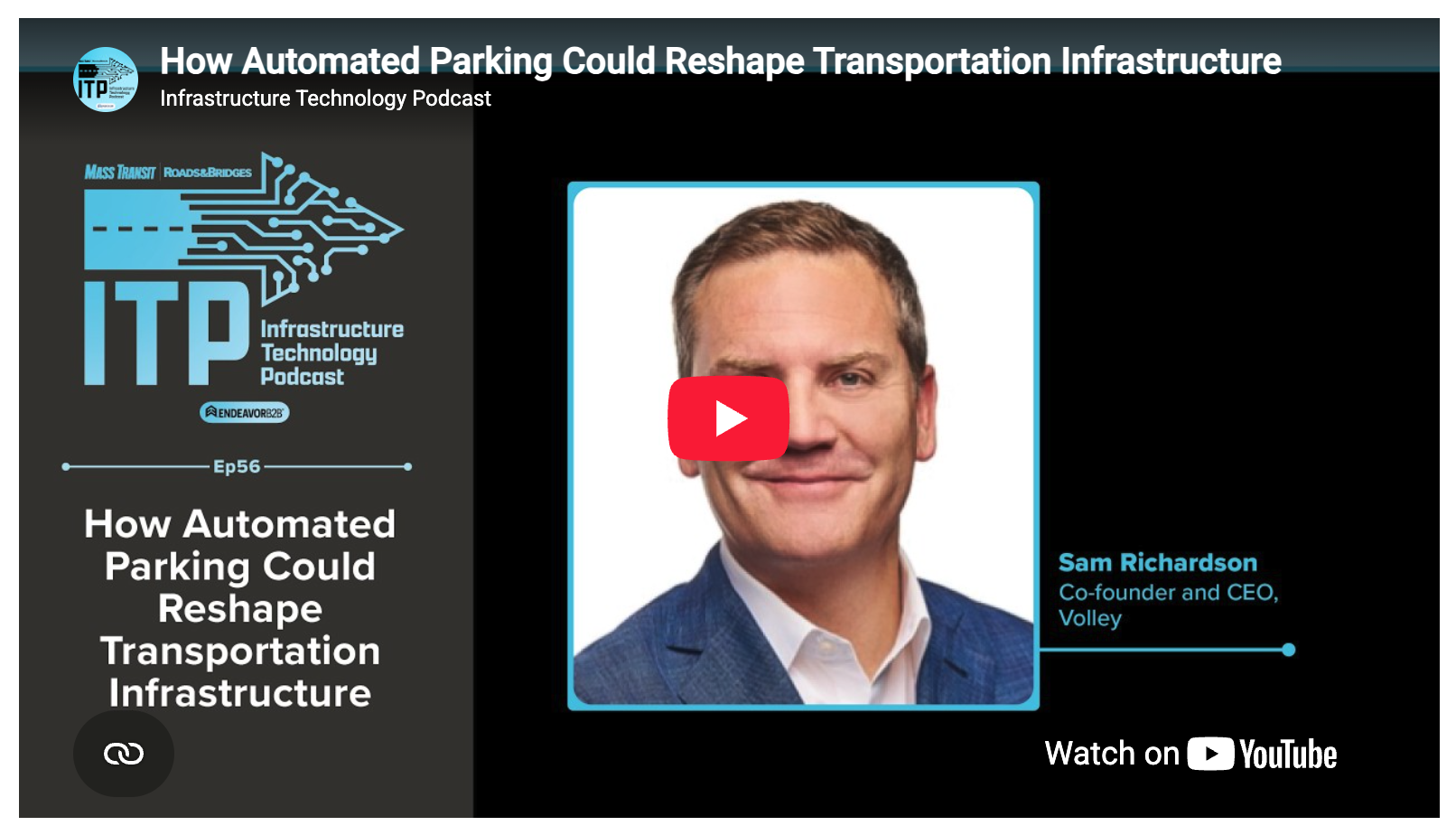

Hosts from Mass Transit magazine and Roads & Bridges ask how robotic parking changes the math for building next to a transit station.
Volley Automation CEO Sam Richardson was the guest on Episode 56 of the Infrastructure Technology Podcast, the weekly show from Mass Transit magazine and Roads & Bridges. Hosts Brandon Lewis of Mass Transit and Jessica Parks of Roads & Bridges interviewed Sam together, the first joint interview in the show’s history. The episode, “How Automated Parking Could Reshape Transportation Infrastructure,” is available with a full transcript on Mass Transit and Roads & Bridges, on YouTube, and on Apple Podcasts, Spotify, and iHeartRadio.
The conversation covered construction economics, software and autonomous vehicle fleets, but the thread running through it was land: who gets to use it, and how much of it parking takes.
The problem with parking next to a transit station
Brandon raised transit-oriented development, the practice of placing housing, retail and services directly beside bus and rail stations so residents can reach transit on foot. Those projects still carry parking requirements, and a conventional ramped garage is a poor fit for a site where every square foot is spoken for.
Sam’s answer was that automated parking makes transit-oriented development easier. A conventional garage gives most of its volume to ramps, drive aisles and the clearance a person needs to open a door. In urban markets, parking accounts for 25 to 40 percent of the cost of a new building, and each level built underground adds five to ten million dollars in excavation. When the parking footprint shrinks, the remaining land can go to housing, parks and public space.
Jessica, who covered Long Island earlier in her career, pointed to the commuter lots around train stations into Manhattan as an obvious fit. Sam described a Long Island client with exactly that situation: a busy grocery store, a surface lot beside the train station and a hospital across the street, and never enough parking for any of them. That project is in design now.
40 to 50 percent more vehicles in the same footprint
In a Volley garage, the driver pulls into a transfer bay, checks in at a kiosk or in the app, and walks away with the keys. A platform robot slides under the vehicle, lifts it on a tray and carries it into a closed storage area with no ramps, no aisles and no people inside. Because nothing needs door clearance or a path to walk, vehicles can be arranged in a geometry Sam compared to Tetris. The result is 40 to 50 percent more parking yield than a self-park garage of the same size. The system lifts up to 10,000 pounds, enough for the heaviest electric SUVs on the road today.
Retrieval works the same way in reverse. The patron requests the car the way they would request a rideshare, and it arrives at the bay facing the street. Nobody walks a garage looking for a space or for their car. Sam noted that parking garages are among the least safe places a person walks through, and the automated system keeps patrons out of them entirely.
Simulate the project before building it
Sam said the first question from city planners is always the same: does it work? Volley’s answer is to show them. Every project begins as a digital twin built from the client’s CAD drawings, Revit files or a sketch. Engineers model the facility in three dimensions and run it against expected demand, so a developer can watch the throughput of their own building, hour by hour, before committing. When clients see how the peaks are handled, Sam said, “you can see the blood rush back to their head.”
That approach reflects how the company is built. Volley writes the software: the orchestration layer that assigns each robot its task and decides where every vehicle sits based on when its owner will want it back. Sam described it as agentic AI applied to robotics, where the software is the central brain and the robot is the agent carrying out its instructions. The robots themselves come from established manufacturers. That split, he said, is what allows Volley to move from the small, constrained urban sites it serves today to larger facilities over the next few years, including airports, hospitals, hotels and venues.
Where autonomous fleets go
Sam expects autonomous vehicles on urban streets by the tens of thousands within three to five years. Those vehicles need somewhere to charge, clean, download data and wait between trips, and if they do that on the street they add to traffic rather than reduce it. A dense automated garage near demand gives a fleet a place to get off the road. Sam described studying how rideshare companies position vehicles across a city by time of day, and building the same logic into how a Volley garage stages cars.
People stay at the front of the garage
Both hosts raised the concern that follows any automation story. Sam’s position: the system is autonomous behind the wall, and the customer-facing side of the garage stays staffed. Volley wants parking operators’ employees trained to run the system, in roles that require more skill and pay better than directing cars into stalls. He pointed to parking operations companies, hospitality valet and transit agencies as natural partners.
Come see it in Denver
Volley’s demo garage at its Denver headquarters is open by appointment to developers and partners. The company moved to Denver from South San Francisco last year, has grown from nine people to 25 in under a year, and has projects underway in Denver, New York, Long Island and Montreal.