New York Has a Parking Problem. The Proposals to Fix It Are Missing Half the Equation.



A response to the New York Times’ “For Nearly 150 Years, Parking Has Driven New Yorkers to the Brink” (June 9, 2026)
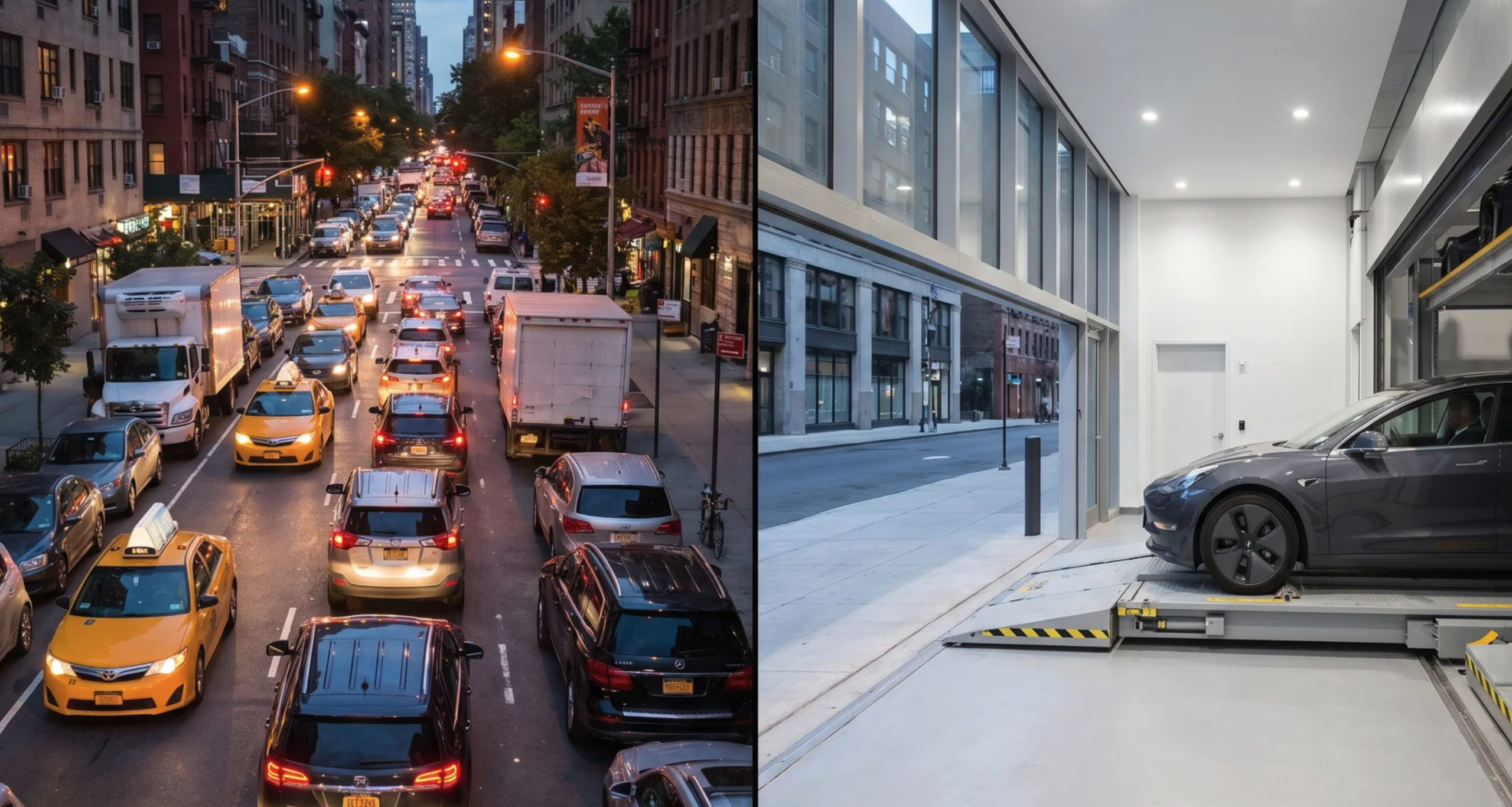
Yesterday, the New York Times published a sweeping look at New York City’s parking crisis. There are three million parking spaces for two million vehicles, and somehow it still doesn’t work. The numbers are staggering but unsurprising: A car-owning New Yorker spends 107 hours per year searching for a spot. Nearly 12 million parking violations are issued annually (including $9M in fines recently shipped to Amazon delivery drivers). The city’s curb appeal is anything but, and the city’s own transportation commissioner describes it as “chaotic and unsafe.”
The article is thorough. It explores four proposals the city is weighing: more metered spots, residential parking permits, dynamic pricing, and stronger enforcement. Each has merit. Dynamic pricing alone, based on San Francisco’s pilot, reduced search time by 43 percent and cut car-based pollution in the process.
But reading the piece, we can’t help noticing what’s absent from the conversation. Every proposal focuses on managing demand for the same street-level infrastructure we’ve had for a century. This article isn’t asking the harder question: what if we fixed the supply side of parking?
The garage problem nobody talks about
When policy experts discuss parking in New York, they tend to focus on the curb. That makes sense, because it’s where the political friction is. But off-street parking garages are a massive part of the equation, and they come with their own cascading failures that rarely make it into the policy debate.
Conventional garages are extraordinarily inefficient. A typical above-grade structure dedicates roughly 60 percent of its total square footage to ramps, drive aisles, and circulation. This is space that exists only to let bumper-scratching cell-distracted humans navigate their vehicles through the building. The remaining 40 percent is actual parking. For a developer in Manhattan, where construction costs can easily exceed $100,000 per stall below grade, that’s a punishing ratio.
Garages are just too expensive to build. Too few get built, and the ones that do exist push costs onto drivers ($500 per month or more, as the Times notes). That price floor keeps cars on the street, where they compound every problem the article describes: cruising for spots, double-parking, blocking hydrants, clogging bus stops, blocking bike lanes, and amplifying conflict.
And inside the garages themselves? The experience is its own kind of dysfunction. Fender benders and vehicle damage from tight turns and narrow stalls. Dimly lit stairwells that feel unsafe, particularly for women walking alone. The low-grade frustration of circling level after level looking for an open space, burning fuel and patience. Garages were supposed to be the solution to street parking chaos. In practice, they just moved the chaos indoors while also making everything more expensive.
What changes when you remove the driver from the garage
There is another way to approach this. Instead of trying to get human drivers to behave differently through pricing, permits, or enforcement, we can just design the driver out of the equation entirely.
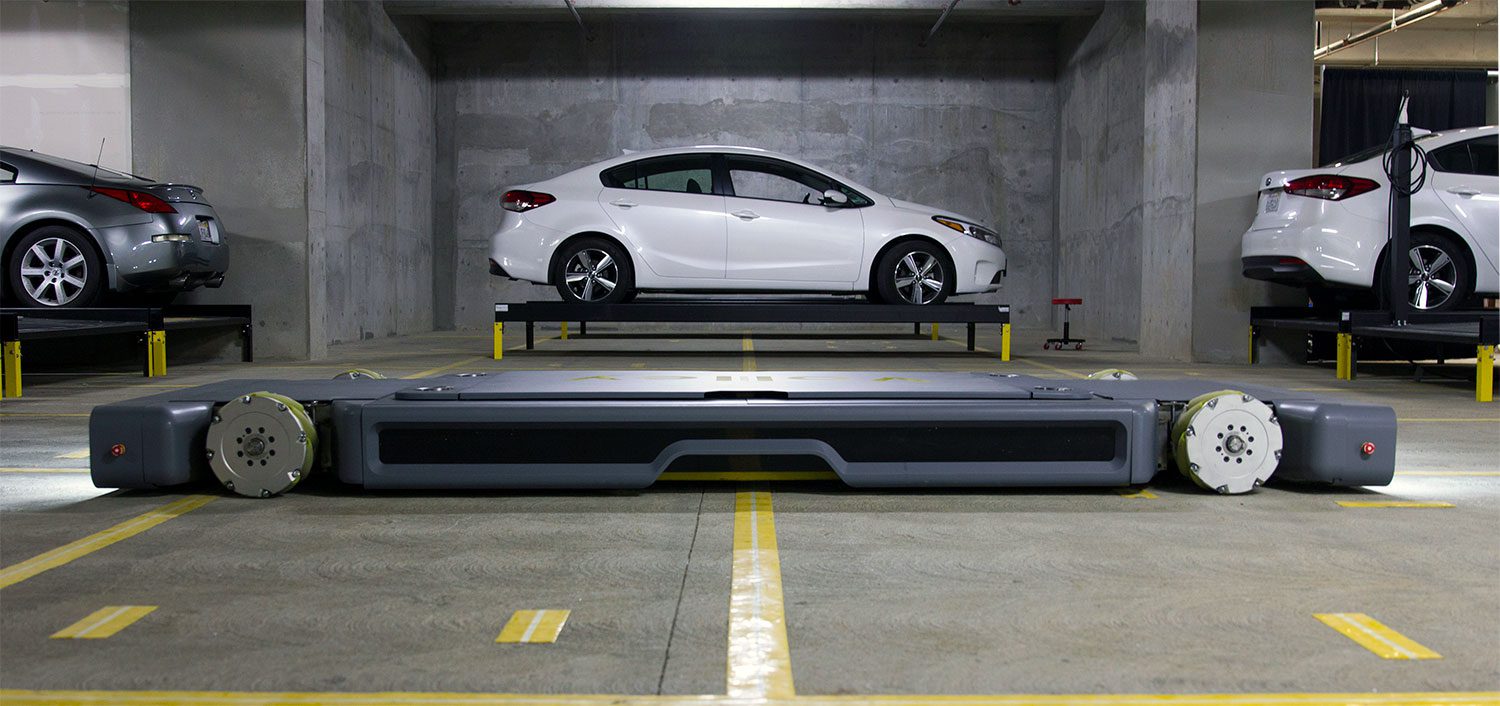
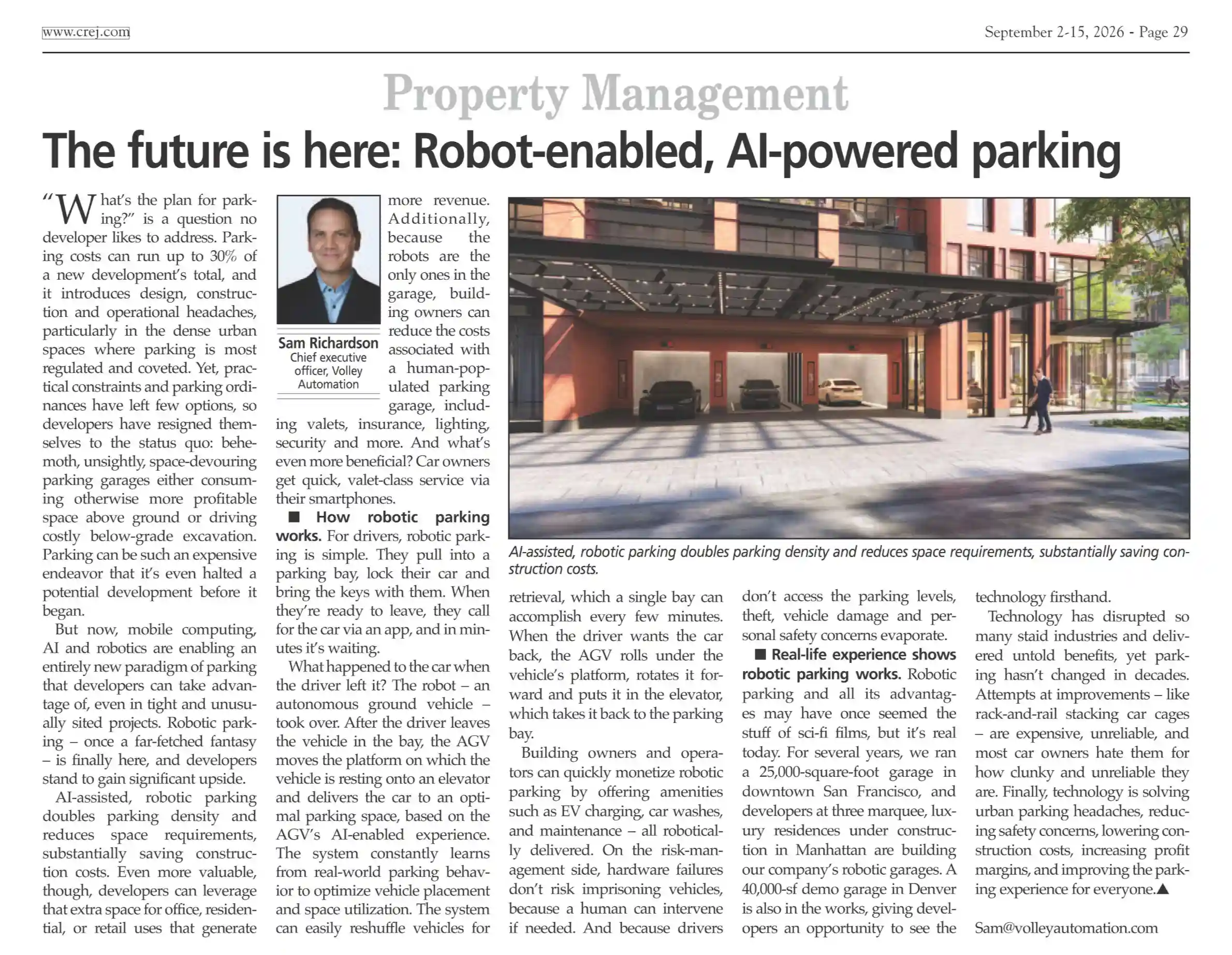
That’s what automated parking systems do. A driver pulls into a ground-level transfer bay, steps out, and walks away. A robotic platform takes the vehicle from there, positioning it in a dense storage grid with no ramps, no aisles, and no circulation space. The car is retrieved the same way, summoned by an app, delivered to the bay, pointed out and ready to go.
The implications for a city like New York are significant, and they map directly onto the problems the Times outlines.
Density. Without ramps and drive aisles, an automated garage can fit roughly twice the cars in the same building footprint. In a borough where every square foot of real estate is contested, that’s a structural improvement. More off-street capacity means less pressure on the curb, which means fewer cars circling, and fewer violations piling up.
Time. The Times reports that New Yorkers lose 107 hours per year to parking searches. That number reflects a system where finding a spot requires the driver to physically hunt for one, competing with every other driver doing the same thing. In an automated garage, parking and retrieval is deterministic. You park your car, the system takes it. You request your car, the system delivers it. No searching, no circling, no competition for the last open space on the third level.
Safety. Parking garages are consistently among the top locations for vehicle break-ins, vandalism, and personal safety incidents in dense cities. If no one walks through the structure, those risks disappear. The transfer bay is ground-level, well-lit, and public-facing. The storage grid is sealed. There are no dark stairwells, no blind corners, and no strangers approaching between parked cars.
Environmental impact. Research has consistently linked circling for parking to measurable increases in localized emissions. One study estimated that 30 percent of traffic in congested urban cores consists of drivers looking for parking. Automated systems eliminate circling both on the street (by guaranteeing a spot before you arrive) and inside the structure (by removing the driver from the parking process entirely). Over the life of a building, the reduction in vehicle miles traveled adds up. And because automated garages have a smaller structural footprint per car, they also require less concrete and steel to build, reducing the embodied carbon of the structure itself.
Policy fixes and infrastructure fixes aren’t competing ideas
Nothing about automated parking argues against the reforms the Times explores. Dynamic pricing is smart policy. Residential permits may help in certain neighborhoods. Better enforcement is long overdue. But these are all interventions on a fixed supply of space that was designed for a different era.
The deeper opportunity is the one that doesn’t show up in City Council debates because it’s an infrastructure question rather than a regulatory one: we must rethink how off-street parking is built. If you can double the capacity of a garage without expanding its footprint, you’ve changed the math on every project a developer is considering. More garages get built. More cars come off the street. The pressure on the curb eases, and the policy tools the city already has start to work better.
New York has three million parking spaces and a system that fails almost everyone. The city is right to rethink its rules. But rules alone won’t solve a problem that’s also physical. At some point, we have to build something different.