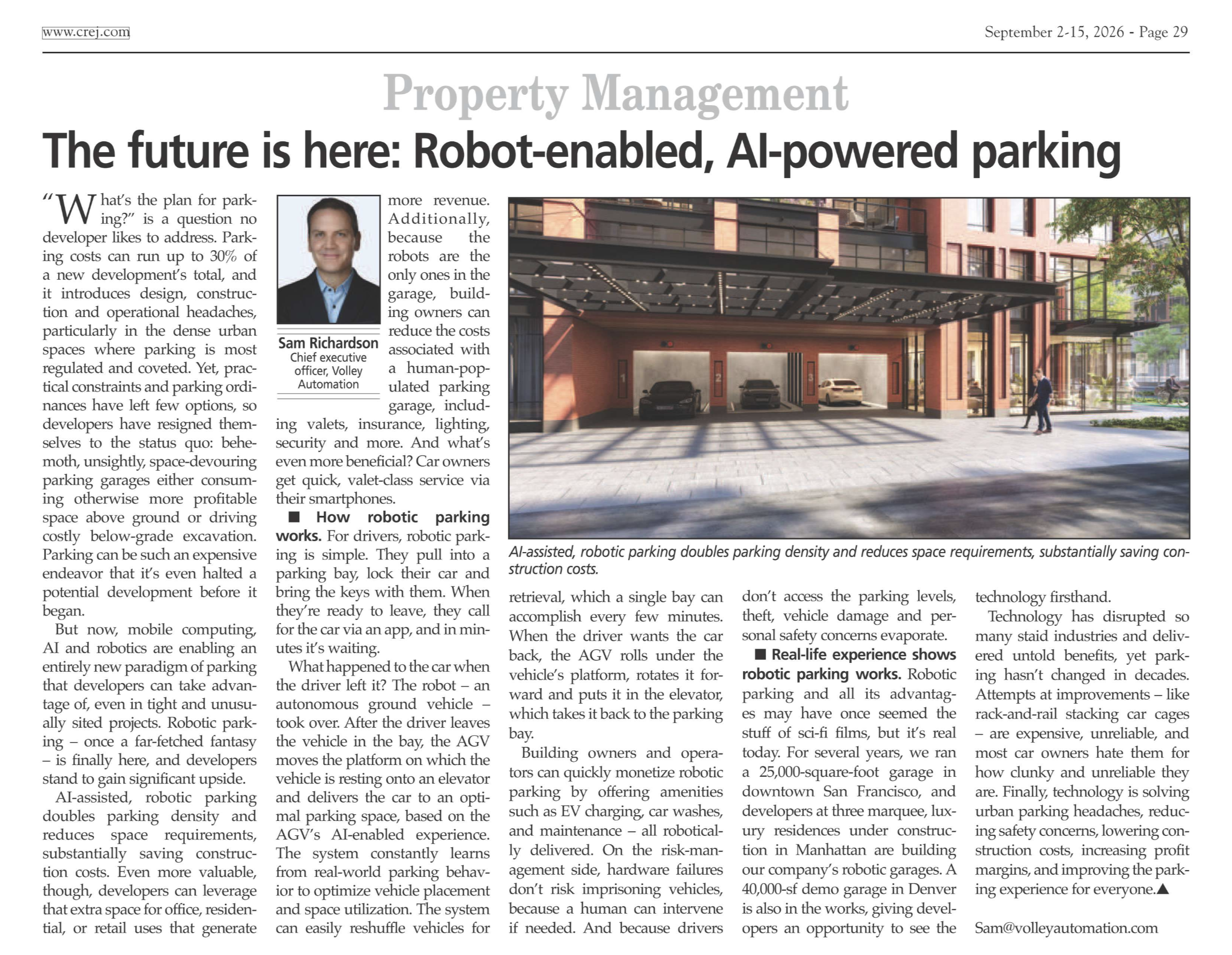
Parking can run up to 30% of a new development’s total cost. In the September 2-15 issue of CREJ, our CEO Sam Richardson lays out how robotic parking changes that math, in Colorado and elsewhere.
The article makes a direct case to Colorado’s developers, owners, and property managers. Volley relocated our headquarters from South San Francisco to Denver this year, and a demonstration garage in Denver is in the works. The people who read CREJ are now our neighbors, and we’re excited to be here.
The question no developer likes
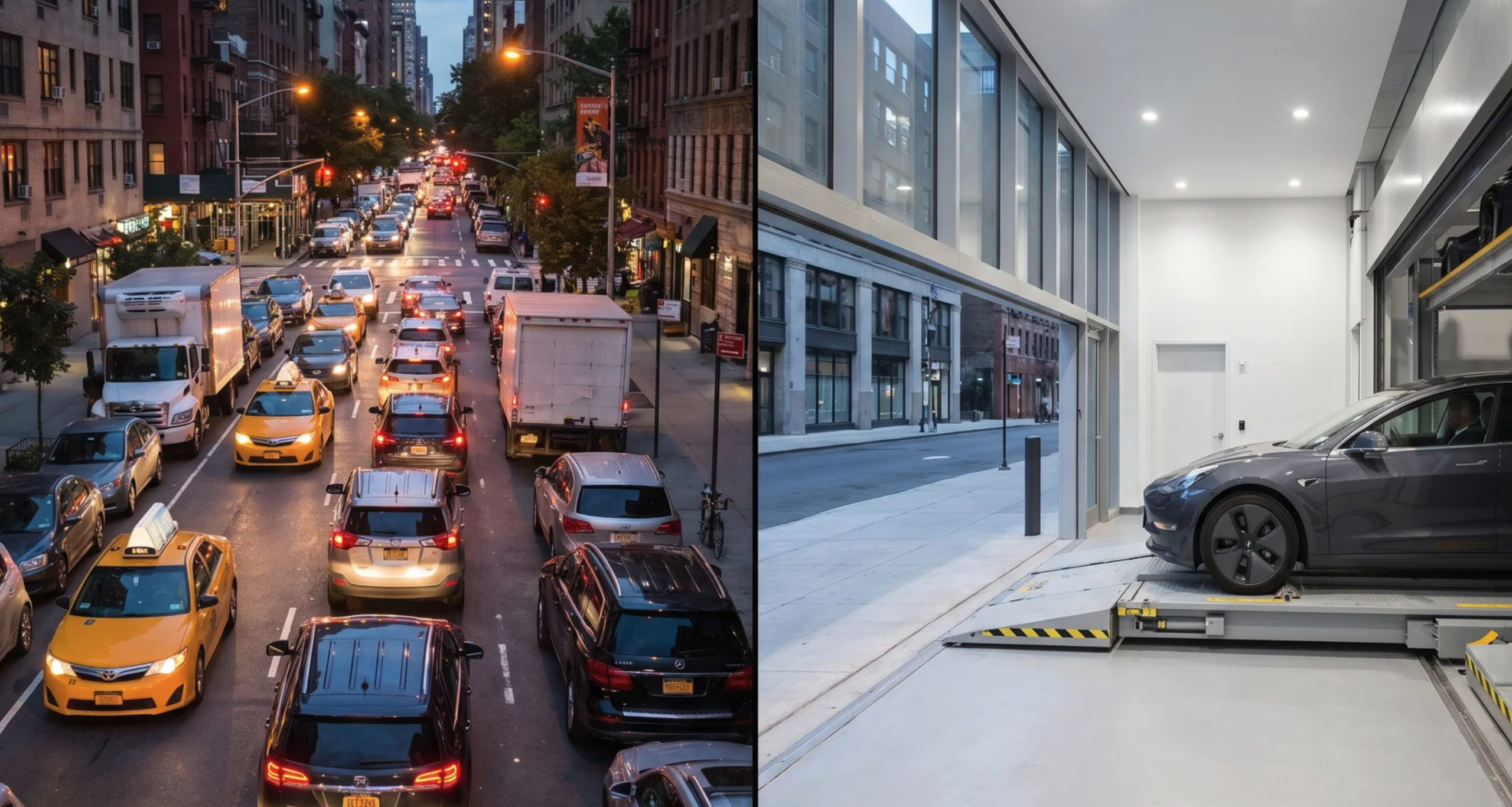
Sam opens with the question every project eventually has to answer: what’s the plan for parking? On a dense urban site, the honest answer is usually painful. Parking can consume up to 30% of a new development’s total cost, and it forces a choice between two bad options: give up revenue-generating space above grade, or pay for costly below-grade excavation. Parking ordinances narrow the options further. The result, as Sam puts it, is that developers have resigned themselves to the status quo, and the parking math has halted potential developments before they began.
What changes when the driver leaves the garage
Our core argument is that more powerful compute, AI,and robotics have all made a new and different kind of garage practical for the first time. These benefits show up in three places.
Space and cost. AI-assisted robotic parking doubles parking density and reduces space requirements, which substantially lowers construction cost. The square footage a conventional garage would have consumed can go to office, residential or retail uses that generate revenue.
Operations and risk. Because robots are the only occupants of the garage, owners reduce the costs that come with a human-populated structure: valets, insurance, lighting and security among them. Drivers never set foot on the parking levels, which removes the theft, vehicle damage and personal safety concerns that come with a conventional garage.
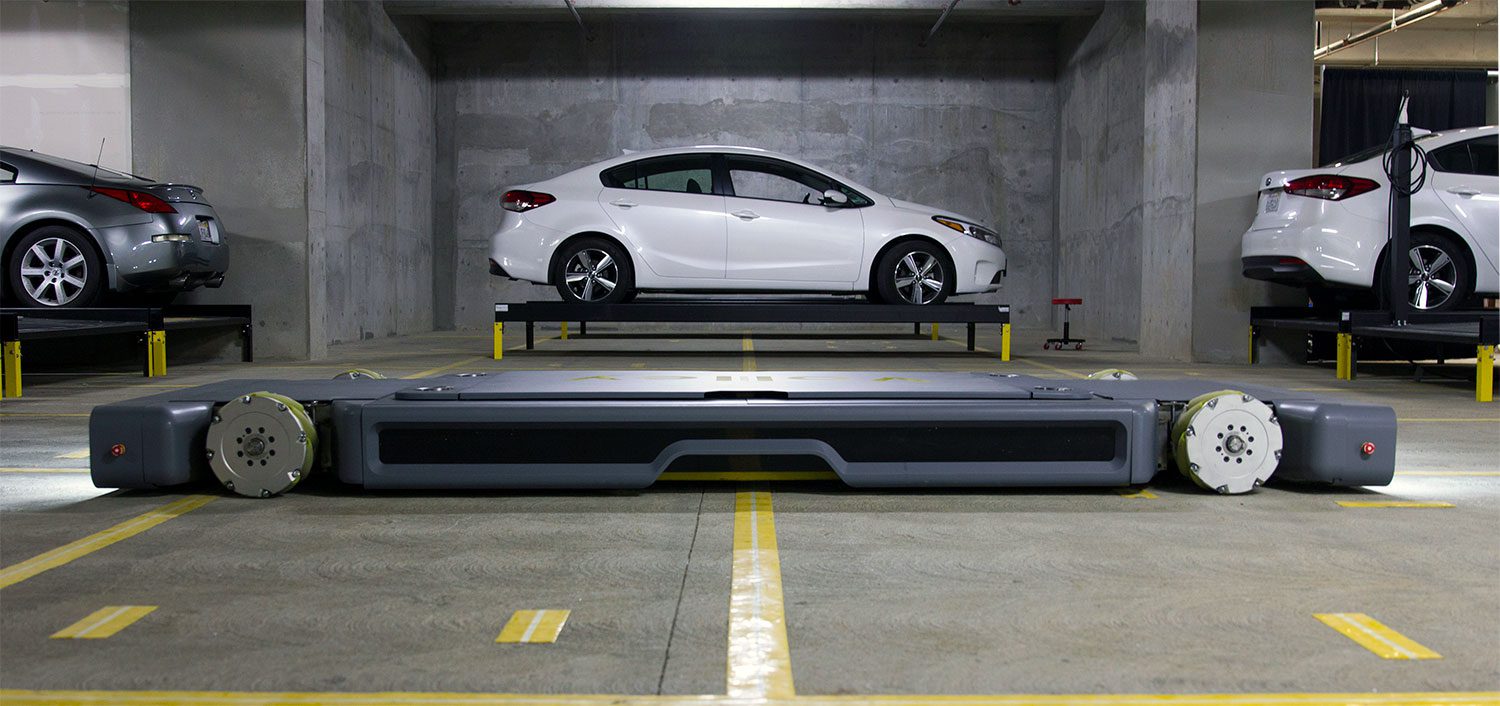
The experience. For drivers, the process is simple. Pull into a bay, lock the car, keep the keys. Request the car through an app and it is waiting within minutes. Behind the scenes, an autonomous ground vehicle moves the platform the car rests on, delivers it to an optimal space and keeps learning from real-world parking behavior, reshuffling vehicles so that a single bay can complete a retrieval every few minutes.
A track record, not a concept
Robotic parking has a credibility problem to overcome. Attempts to improve on the conventional garage, such as rack-and-rail stacking car cages, have a history of being expensive and unreliable, and most car owners dislike them for it.
Volley’s system is different, and it has a track record. For several years, we ran a 25,000-square-foot garage in downtown San Francisco. Developers at three marquee luxury residences now under construction in Manhattan are building our robotic garages. And a demonstration garage in Denver is in the works, which will give developers a chance to see the technology firsthand, here in our home city.
An open invitation to Colorado
Parking has not changed in decades, and the sites where it has been the deal-breaker are the sites where a different approach pays off most. If parking is the line item holding back a project along the Front Range, we would like to show you what a garage looks like without ramps, aisles or drivers inside it.
Read Sam’s full piece attached here or in the September 2-15 issue of the Colorado Real Estate Journal, and reach out at volleyautomation.com to arrange a conversation or a visit to our Denver facility.